So...beautiful. And you changed your header photo. For some reason it took me back not seeing the Yuccas but I'll be damned if the new photo isn't just as awe-inspiring.
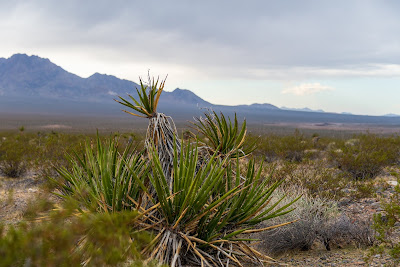
The new header photo is of the proposed Calico Solar power project site, with the Cady Mountains in the background. Lots of Mojave fringe-toed lizard in the area from which the photo was taken.
The Trump administration is again touting the practice of mowing thousands of acres of desert vegetation as environmentally-responsible, despite a preponderance of evidence to the contrary. The draft environmental review of the Yellow Pine Solar project in southern Nevada claims that vegetation mowing - as opposed to bulldozing - will yield positive outcomes that are highly doubtful. This positive framing of the construction practice misleads the public and decisionmakers and ignores decades of scientific research regarding the impacts of mechanized disturbance on desert wildlands. According to the draft environmental review: "Mowing is becoming the standard on large site-type ROWs to prevent permanent impairment of public lands (as mandated by FLPMA) and in lieu of off-site mitigation... Mowing methods are designed to help preserve soils, biological soil crusts, soil seed banks, native perennial vegetation diversity and structure, and cacti and yucca species, and t...
The Trump Administration this month released an assessment that concludes that a solar developer can crush and mow vegetation across several square miles of prime desert tortoise habitat, and still consider those lands as viable habitat for the species. The silence of some national-level environmental groups regarding the unconventional and unscientific conclusion appears to signal their comfort taking risks with a species already facing significant peril, as well as these groups' inability to champion more sustainable locations to generate clean energy in Nevada. The biological opinion released by the Trump Administration constitutes the official position of the Fish and Wildlife Service regarding the impacts of the proposed Gemini Solar project; its curious willingness to declare heavily disturbed lands as viable tortoise habitat was necessary for the project's approval because the project would be built on lands that have been identified as a vital habitat linkage sustai...
As we gather to demand bold action to end fossil fuels, we can also ensure that wildlands no longer have to shoulder the sacrifice for our consumption of electricity. Renewable energy technology is extremely flexible and scalable, which means that we can replace fossil fuels without replacing wildlife habitat. A Million Rooftops!: Even with relatively tame policy incentives, California was able to install over 8,240 megawatts of rooftop solar . That is clean energy generated across over nearly 1 million rooftops. And there is still room for plenty more! In fact, a study found that one metropolitan area had enough rooftop solar potential to power half of the state of California. Smart Locations for Large Projects: Through smart environmental policies, California has also guided thousands of megawatts of large-scale solar projects to already-disturbed lands . One solar project on former agricultural land in the Central Valley could generate up...


So...beautiful. And you changed your header photo. For some reason it took me back not seeing the Yuccas but I'll be damned if the new photo isn't just as awe-inspiring.
ReplyDeleteThe new header photo is of the proposed Calico Solar power project site, with the Cady Mountains in the background. Lots of Mojave fringe-toed lizard in the area from which the photo was taken.
ReplyDelete