Silver State South Begins Environmental Review
The Bureau of Land Management (BLM) started the environmental review of the Silver State South solar project, which would destroy or fragment up to 20 square miles of desert habitat in the Ivanpah Valley. Silver State would be built by First Solar Inc, which has also proposed constructing the 3.4 square mile Stateline solar power project nearby.
The BLM is accepting public comments and issues to consider as part of its initial scoping period until 31 October 2011. You can email comments to SilverStateSouthEIS@blm.gov .
Points the BLM should evaluate in its environmental review include:

The Silver State solar project right-of-way would be bigger than some cities. The Google Earth images below show how big the Silver State solar project is when compared to other cities. More comparative images can be viewed here and here.
The Silver State South solar project may produce about 340 MW of electricity if it is built. But a study by UCLA found that the rooftops in the City of Los Angeles could hold enough solar panels to generate 5,500 MW. The rooftops throughout the county of Los Angeles could produce up to 19,000 MW.
Although First Solar may not install solar panels on the entirety of its 20 square mile right-of-way (13,043 acres), its proposed location at the choke point of the Ivanpah Valley will ensure that any habitat destruction has significant impact on the viability of the area to serve as a functional wildlife corridor. The environmental review will assess the impacts of Silver State South, which is the larger second phase of the project. Silver State North was approved last year.
The BLM is accepting public comments and issues to consider as part of its initial scoping period until 31 October 2011. You can email comments to SilverStateSouthEIS@blm.gov .
Points the BLM should evaluate in its environmental review include:
- The Silver State South solar project could block a wildlife corridor through the Ivanpah Valley, and particularly cut off an important genetic linkage for the threatened desert tortoise. Maintaining habitat connectivity is an essential element of the recovery plan for the desert tortoise.
- The project would destroy desert habitat identified by the Nature Conservancy as "biologically core" and noted for hosting an above average richness of rare species, a testament to the high quality of the habitat.
- The area provides foraging habitat for Golden Eagles and desert bighorn sheep, and probably hosts burrowing owls and rare plants species.
- The BLM should evaluate alternatives to this destructive project, such as siting it on already-disturbed lands or consider rooftop solar.

The Silver State solar project right-of-way would be bigger than some cities. The Google Earth images below show how big the Silver State solar project is when compared to other cities. More comparative images can be viewed here and here.
 |
| The outlines of the Silver State solar project transposed on downtown San Francisco. (Click on image to expand) |
Although First Solar may not install solar panels on the entirety of its 20 square mile right-of-way (13,043 acres), its proposed location at the choke point of the Ivanpah Valley will ensure that any habitat destruction has significant impact on the viability of the area to serve as a functional wildlife corridor. The environmental review will assess the impacts of Silver State South, which is the larger second phase of the project. Silver State North was approved last year.
 |
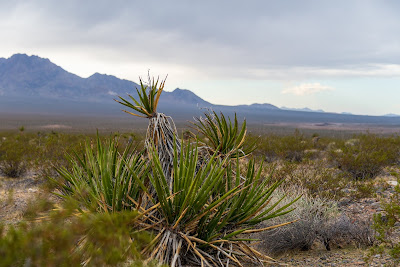
| This photo shows some of the prime desert tortoise habitat in the Ivanpah Valley. The Clark Mountains in the background. |

Comments
Post a Comment